Institute for the Study of Muslims and Islam in India

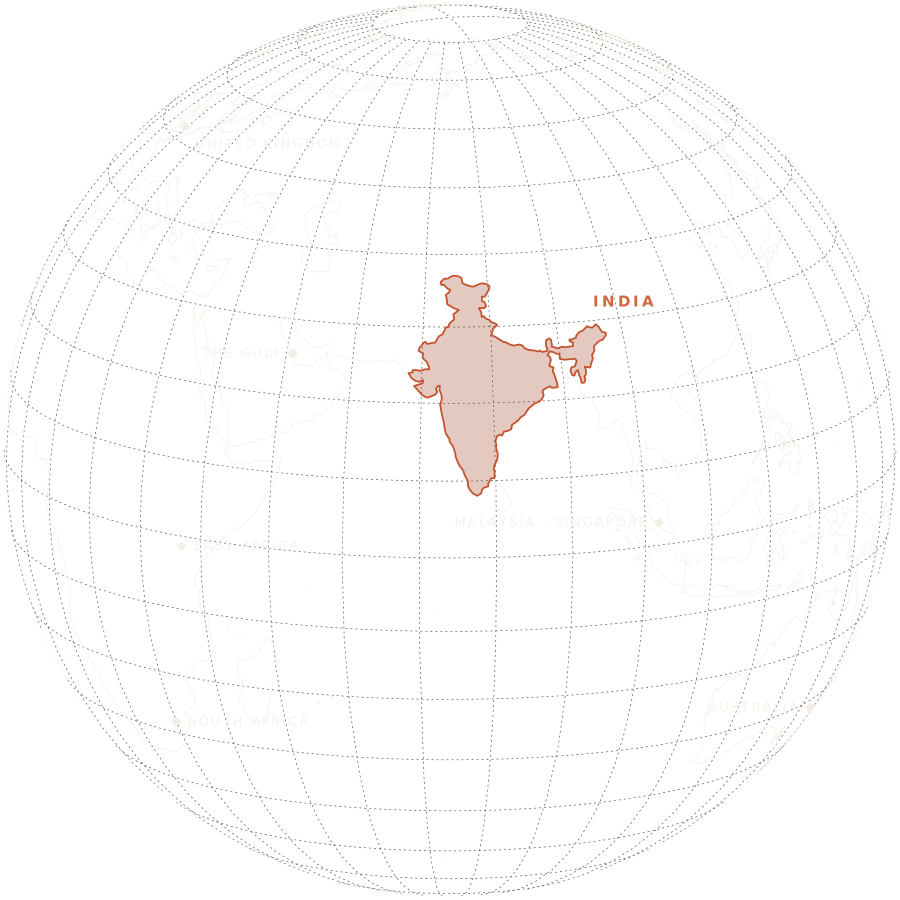
By 2050, India is projected to have the world’s largest Muslim population

From about 200 million today to 311 million by 2050.

Today: World Population Review, 2026 (14.6 per cent of India). 2050: Pew Research Center projection, 2015.

ISMII, based in Chicago, studies Indian Muslims through research, teaching and archives.

An institute ofAmerican Islamic College
In partnership withThe Islamic Seminary of America

Source: Coastlines Natural Earth

Today

Among the most diverse Muslim communities in the world, and among the least studied

Few Muslim communities anywhere span so many regions, languages and traditions. Fewer still have so little dedicated scholarship.

Places

From Kashmir to Kerala and from Assam to Gujarat, Muslims reside in every state of India, in cities, towns and villages.

Languages

Urdu, Bengali, Malayalam, Kashmiri, Gujarati, Tamil and many more, each with its own Muslim literature.

Traditions

Many schools of thought, spiritual paths and local communities, each with its own institutions, scholars and ways of living the faith.

1 in 10of the world’s Muslims live in India.World Population Review, 2026
0 of 38Islamic-studies centres across the US and Canada dedicated to Islam in India.2020
4.8 mIndian Americans, among them an Indian Muslim community of uncounted size, in the absence of a religion based Census in the US.Pew Research Center, from US Census Bureau data, 2022

Our response

The scholarship on Indian Muslims and Islam in India remains stunted globally. ISMII is an endeavor to fill that lacuna.

The scholars of 2050 are already in school. Building the academic infrastructure now gives them stronger resources, better-trained scholars, preserved archives and a more developed body of knowledge. The work is needed, it is achievable, and it has begun.

The Institute for the Study of Muslims and Islam in India will build that infrastructure through research, teaching, preservation and public programmes.

Academic freedom

Consequential ideas are better understood when they can be examined, placed in context, debated and criticised.

Scholarly integrity

We hold our work to a simple standard. What we claim, we can source; what we count, we date; what we expect, we mark as expected, not as settled.

Pluralism

Indian Muslim life was never lived alone. It was shared with neighbours of many faiths, and ISMII studies it in that shared light.

Inaugural event

Introducing ISMII

The Institute opens with an introduction to its purpose and plans, and an open conversation with all present.

Date
10Saturday
October 2026
Time
12:00 PM Chicago6:00 PM London10:30 PM New Delhi
Where
OnlineFree and open to all
Speakers
  • Shaykh Dr Mohammad Akram Nadwi

    Shaykh Dr Mohammad Akram Nadwi

    Dean, Cambridge Islamic College
    Principal, Al-Salam Institute

  • Dr James E. Jones

    Interim President, Chief Academic Officer, American Islamic College

  • Azhar Azeez

    Chief Executive Officer, Islamic Society of North America

Islam in India

Three moments from the history

Arrival by sea, a producer of knowledge, and renewal in print.

By tradition, 629 CE · Kodungallur

Arrival by sea

Kerala’s tradition dates the Cheraman Juma Masjid at Kodungallur to 629 CE, within the lifetime of the Prophet. Islam reached India’s coast through trade and contact, and was part of the coastal world long before it was part of the political one.

The Indian Ocean from the Red Sea to the Strait of Malacca, with the maritime corridors.Coastlines Natural Earth · routes schematic
Mughal India · the Hijaz · the Ottoman world

A producer of knowledge, not only a recipient

Indian scholars kept close ties with Mecca and Medina, and Indian Sufi lodges stood in Jerusalem, Damascus and Istanbul. A compendium of Hanafi law compiled in Mughal India is still known across the Muslim world as al-Fatawa al-Hindiyya, the Indian fatwas.

The westward network: from Delhi, Hyderabad and the coasts to the Hijaz, Jerusalem, Damascus and Istanbul.Coastlines Natural Earth · routes schematic
1858 – 1899 · Lucknow, Deoband, Aligarh

Renewal in print

After the collapse of Muslim political power, a seminary at Deoband in 1866 and a college at Aligarh in 1875 rebuilt Islamic learning, and the lithographic press carried it to a mass Urdu readership, widening who could hold religious authority.

Read the full history

Lithographed Urdu title page of Fasana-e-Azad, volume 3, printed by the Naval Kishore Press in 1899
Title page of Fasana-e-Azad, vol. 3, Naval Kishore Press, Lucknow, 1899.Wikimedia Commons · public domain

Support the study of Muslims and Islam in India.